
Finding Middletown Resident Records
Middletown is a township, not the Monmouth County seat, so a useful search begins by matching the question to its keeper. Use an address or owner name in the county property system for an ownership lead. Use the New Jersey voter tool only to confirm a supplied person's registration status. Use a directory, obituary index, church record, or the county's 1875 census collection when the question concerns an earlier household. A record may list an owner, a court party, a voter, or an historical householder. Those labels are not interchangeable.
Start with the narrowest fact already known and keep the record date beside it. A parcel card can identify an assessed owner but cannot establish every occupant. A printed directory is a publisher's snapshot, not proof of continuous residence. For a name with more than one plausible match, compare spelling, middle initial, village or postal label, and a second source before drawing a conclusion.
- Write down the full name or street, the likely period, and whether the question concerns ownership, a public filing, or family history.
- For a property question, search OPRS by Middletown Township and address, then retain the block, lot, qualifier, and assessment year.
- Open the related deed or tax record only after the parcel is confirmed, and record the instrument date or selected tax year.
- For an older person, test village and post-office names in the 1875 census, Monmouth directory runs, newspapers, and obituary indexes.
- When the online index is incomplete, ask the named custodian for the record series and date range rather than requesting every record associated with a person.
The same question can require more than one access channel. OPRS provides the online county index; the Tax Assessment counter can clarify an assessment record; the Hall of Records is the county route for land material; and the Township Clerk handles municipal records and requests. The Historical Room, MCHA, and the State Archives supply library, appointment, microfilm, and reading-room routes when a record predates a convenient online index. Save the portal address and date of each search so a later researcher can repeat it.
Note: An index result is a lead, and its date, scope, and source should travel with any note made from it.
Middletown Records Custodians
Three offices form the practical core of Middletown resident records. The Monmouth County Clerk keeps land recordings and the county's public records systems. The Middletown Tax Assessment office holds local assessment and ownership-related information. Election matters are divided between New Jersey's public status tool, the county election offices, and the Township Clerk. A request belongs with the office that actually maintains the record, not simply the office nearest an address.
County records are centered in Freehold, while municipal records are held at Middletown Township offices. The County Clerk's OPRS system brings together several index types, but each has its own coverage and access limits. Street-by-street parcel work belongs on the Middletown By Street page, where the address chain is handled in detail.
The Township Clerk also serves as custodian of municipal records, election administrator, and local registrar contact. Its archival holdings begin in 1897; earlier local records were transferred to Rutgers University. The county layer has a different role: the Clerk maintains deeds, mortgages, trade names, election material, subdivision maps, archives, and public-record indexes. A research note should state which layer supplied the item, because a township minute, county deed, and state index can refer to the same place but answer different questions.
For a record that is not posted online, a municipal OPRA request may be mailed, hand-delivered, or submitted through the documented electronic route. County requests also have an online transition and paper fallback. Library and archival research work differently: staff can identify a volume or collection, while an appointment or onsite connection may be needed to inspect it. Treat the office contact, the online portal, the counter, and the archive as complementary access paths instead of assuming the web result is the complete file.
Monmouth County Clerk
Hall of Records, 1 East Main Street
Freehold, NJ 07728
732-431-7324
Monmouth Elections Office
300 Halls Mill Road
Freehold, NJ 07728
732-431-7802 ext. 7150
Middletown OPRS Search Modes
Monmouth County's Consolidated Records Search has four useful routes for Middletown. By Address uses the legal municipality and a street entry. By Block and Lot narrows the result to the parcel identifiers. By Map begins with a selected point and radius controls. By Name looks for the current owner or part of that name. The interface notes that a street can be searched as a meaningful fragment, which helps when a house number or suffix is uncertain.
Search results need a second look before a name is carried forward. Compare the displayed situs address, block and lot, assessment year, map position, and deed reference. A postal label can differ from the legal municipality, and a current owner can be a trust, estate, company, or person who does not occupy the parcel.
| OPRS route | Key input | What it supplies |
|---|---|---|
| By Address | Middletown Township and street text | Parcel leads and situs information |
| By Block and Lot | Municipality, block, lot, qualifier | Exact parcel retrieval |
| By Map | Selected map point and radius | Spatial parcel context |
| By Name | Municipality and owner name | Current assessed-owner leads |
The companion Tax Board search adds address, owner, block-and-lot, aggregate, year, and exemption routes. A year is selected by the user, but the county does not state one universal earliest online year. That limitation matters when comparing a current parcel card with an older deed or a historic map. When a result list is long, record an exclusion too, such as a different municipality, street suffix, block, or date, rather than returning later to the same false match.
A useful parcel note lists the displayed street address, municipality, block, lot, qualifier, owner name, assessment year, land and improvement values, total assessment, sales or deed reference, and map context only when those fields actually appear. It also distinguishes the owner mailing address from the situs. This small inventory makes it possible to compare two search sessions without copying sensitive fields. It also shows why the address search is a property-research tool rather than a census of residents along every street.
Middletown Voter Status Search
New Jersey's voter-status check is designed to confirm an individual's registration, not to create a broad resident list. The documented form uses first name, optional middle initial, last name, and birth month and year. Exact spelling matters, especially with a hyphenated surname, a married name, or a middle initial. The result is limited to status-oriented fields and should not be treated as a full street roll.
New Jersey law makes defined voter-list fields public, while signatures, unique identifiers, telephone numbers, and email remain protected. A voter may also have an address protection available under state law. A status result should therefore be used only for its stated purpose and checked against a separate, date-appropriate record.
The wider voter file is held through county election administration and has its own request rules. Public voter-list fields may include a name, address, date of birth, party affiliation, and voting history, subject to statutory exceptions. The public status screen is narrower than that file. It is also distinct from the county OPRS election categories, which include dated reports such as past results, vote-by-mail lists, and early-voting lists. No one of these sources is a complete historic resident roll.
The state directory of county election officials identifies the Monmouth contacts for questions that the online status route cannot resolve.
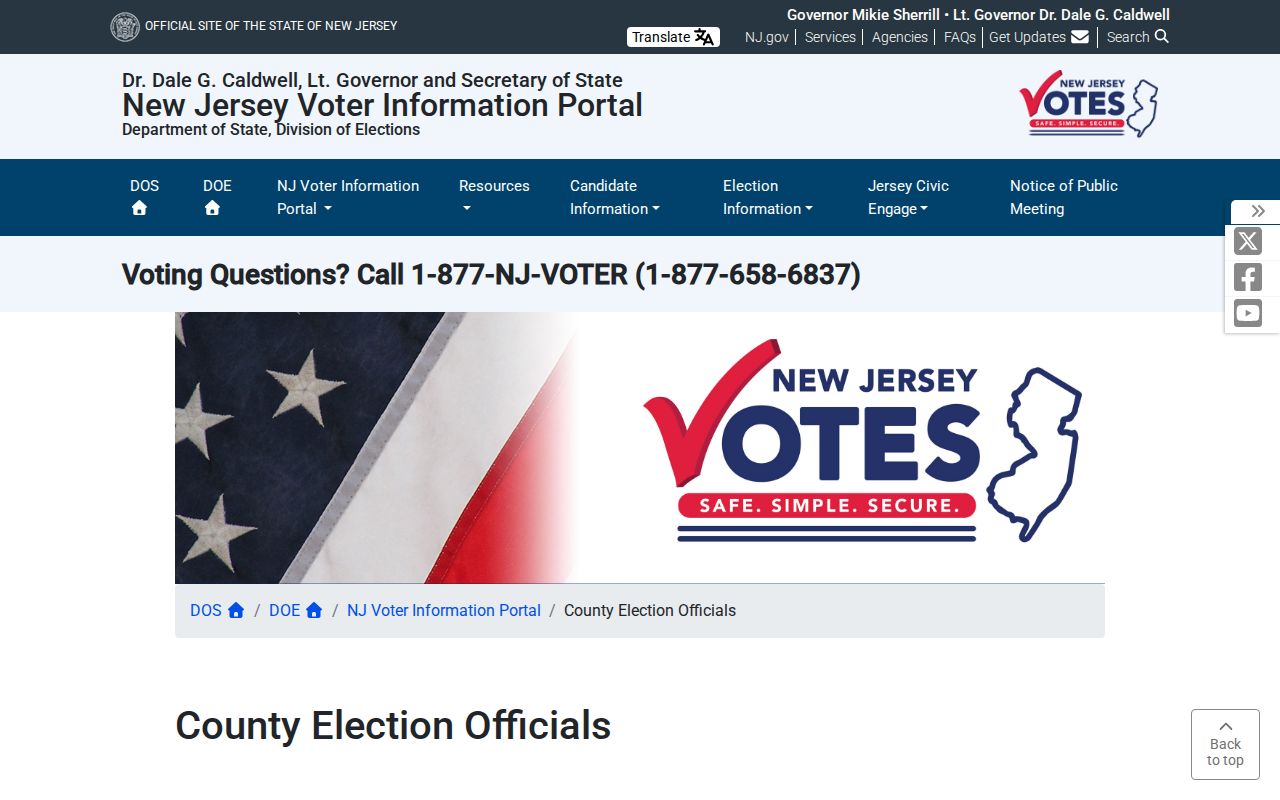
That contact path is more appropriate than guessing from a stale registration result or trying to infer a household from a shared address.
Middletown Ownership Is Not Residency
Property records are often the best address-based starting point, but they establish an ownership or assessment relationship. The parcel's situs address is its physical location. The owner mailing address may be elsewhere, may belong to an agent, or may reflect an estate or business arrangement. Those two fields must remain separate in a research note.
A deed adds a recorded transfer date, grantor, grantee, instrument reference, and legal-description trail. It does not identify every person who occupied the address. For a present-day name question, label the finding as an owner of record for the stated year. For a past household, combine the parcel trail with dated directories, census material, newspapers, or other historical evidence.
- Parcel
- A mapped unit of land identified by block, lot, and sometimes a qualifier.
- Situs address
- The physical address assigned to a parcel, distinct from a tax mailing address.
- Index
- A finding aid that points to a record; it is not always the document image itself.
- Criss-cross directory
- A date-specific directory arranged by address, useful for historic household clues.
Tax maps and the OPRS parcel map add a physical check to the record trail. A map boundary may touch a road, water, a common element, or an apparent gap, so an adjacent shape is not enough to identify the next parcel. Select the adjacent block and lot, then run a fresh property search and compare it with the deed's legal description. Sales data and an assessment record can provide dates and references, but a reported sale may have a non-usable classification and should not be treated as a market conclusion.
Construction and land-use material can add place context without becoming a household list. Middletown Development Services links property-map and code functions, and the township's zoning-map page lists editions ranging from 1970/1977 through 2025. The township announced an SDL permit portal in 2025 for accounts, inspection requests, and permit or request status. The researched notices do not establish public search fields, historical coverage, or a fee schedule, so the portal should be treated as a current service lead rather than proof of a searchable address history.
Current Middletown Resident Directories
No official current directory lists every Middletown household. The sources below each document a narrower relationship: assessed ownership, a recorded transfer, public voter status, a court party, an estate filing, a public credential, or an institution's historical context. Choosing the right label prevents an owner from being mistaken for an occupant or a filing party from being mistaken for a resident.
| Record source | Relationship shown | Custodian | Access route |
|---|---|---|---|
| Assessment parcel card | Assessed owner and parcel relationship for a tax year | Middletown Tax Assessment / OPRS | Free county search |
| County deed index | Recorded grantor, grantee, date, and instrument reference | Monmouth County Clerk | OPRS index; copy rules vary |
| Voter status check | Limited registration status in municipality and county | New Jersey elections | Individual status route |
| Surrogate estate index | Estate lead and probate-office trail | Monmouth County Surrogate | Free index, 1991-present |
| Historical directories | Past name, post office, occupation, or household clue | Libraries, MCHA, archives | Collection-specific access |
For a one-person question, compare the record's stated relationship, date, and geographic field before continuing. The Middletown resident lookup route applies that verification method to a supplied name rather than rebuilding the full property trail.
The present-day sources also differ in access. OPRS property and owner-name modes are free searches. Deed images or certified copies can have record-specific copy rules. The estate index has an agreement gate and states that it is not a complete public-record search. A court inquiry excludes confidential material. Historical directories and library collections can require onsite access, an account, an appointment, or a staff request. When comparing results, list the access condition as well as the custodian and date.
Middletown Court Record Routes
Court access is split by case type. Middletown Municipal Court handles local traffic and lower-level municipal matters and shares services with Keyport. New Jersey Courts' public tools are the route for statewide Superior Court matters, while federal matters are separate. A docket is the court's case identifier and event list. A person listed on one does not by itself establish identity, residence, or the outcome of a case.
Municipal ticket searches and broader court-party searches use different information. Sealed, confidential, and redacted material will not appear in public access. Use the case type, docket or ticket detail, and filing date to test whether a result belongs to the person being researched.
New Jersey Courts' public case-jacket materials describe docket, party-name, and judgment searches for public court records. A party-name route requires a last and first name, and short search terms can be exact-match only. NJMCdirect uses its own ticket or complaint information for municipal matters. Keep a court result's docket, filing date, and status separate from property or voter findings. A court record can establish that a public case has a listed party; it does not convert the listed address into a current residential fact.
The Middletown Municipal Court page shows the local court service route and its connection to statewide court tools.
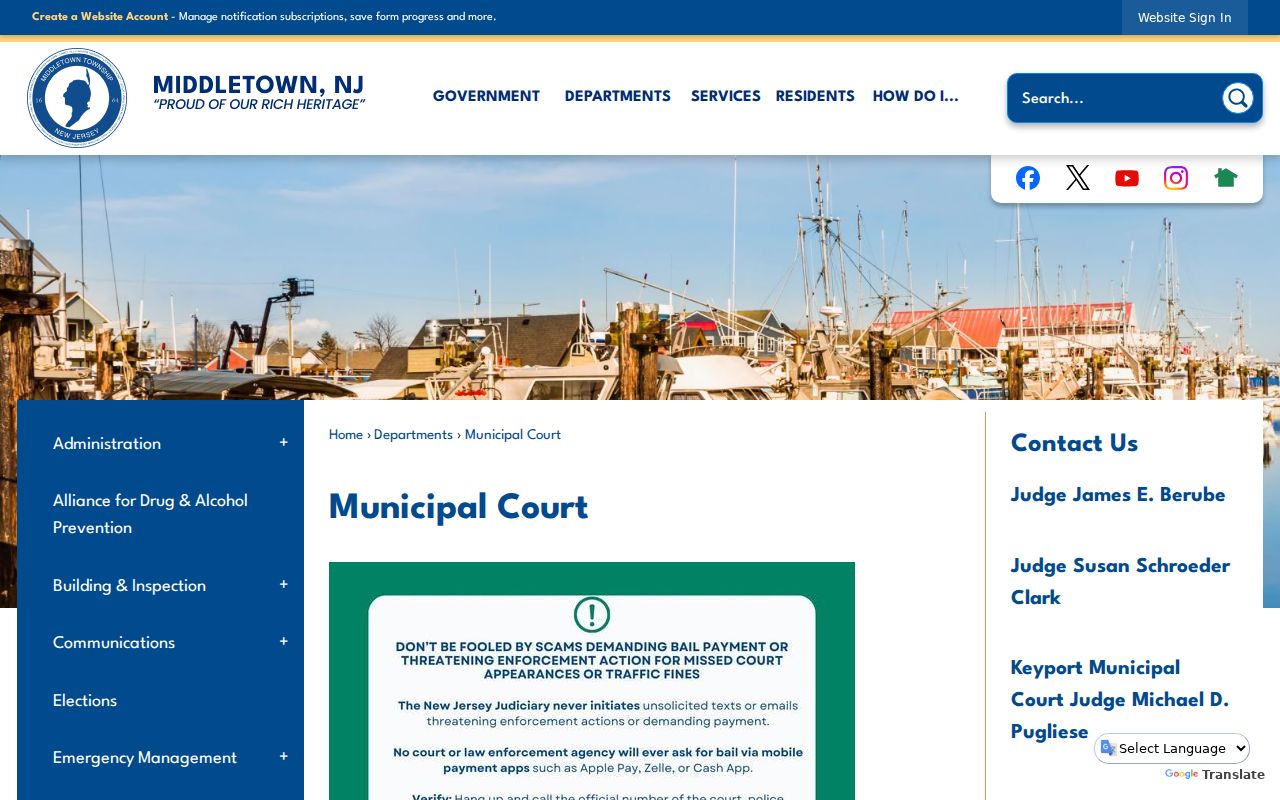
The court route is a record of public case activity, not a substitute for the county's ownership and archival sources.
Middletown Vital Record Timing
Vital records have a separate custodian and access rule. Middletown's local registrar is the practical office for recent local certificates, while the state office handles current statewide orders and the State Archives serves older genealogy work. Current non-genealogical birth records under 80 years, marriage records under 50 years, death records under 40 years, and domestic-partnership or civil-union records are restricted under New Jersey law.
Eligibility, identification, relationship proof, delivery method, fees, and timing vary by record class. A historical index may help establish an event, but it is not the same as a certified copy. Keep the event date, the requested purpose, and the custodian's instructions together before sending an application.
The State Archives provides broader historical context for births, marriages, and deaths along with county land, census, surrogate, tax, court, military, and naturalization material. Its searchable vital-index coverage is itself date-limited: births 1848-1925, marriages 1848-1900, and deaths 1848-1900 in the documented collection. Use an index as an event lead, retain its jurisdiction and date, and then follow the archive or registrar procedure that fits the record class.
Middletown OPRA Request Paths
The New Jersey Open Public Records Act, commonly called OPRA, can reach non-exempt government records held by the appropriate custodian. For a municipal record, the Township Clerk is usually the starting point. County records go to the County Clerk or another county custodian. A focused request names the record series, office, street or block and lot when relevant, date range, and desired format. It does not require an agency to create a new report or expose protected details.
Middletown's form provides for electronic, mail, pickup, inspection, and other delivery choices. The ordinary response period is seven business days, with statutory exceptions and written delay notices. The published municipal copy charges are $0.05 for a letter-size page and $0.07 for a legal-size page; special service, delivery, and a deposit can apply in the documented circumstances.
Middletown Public Records Services identifies municipal archival and public-record access routes.
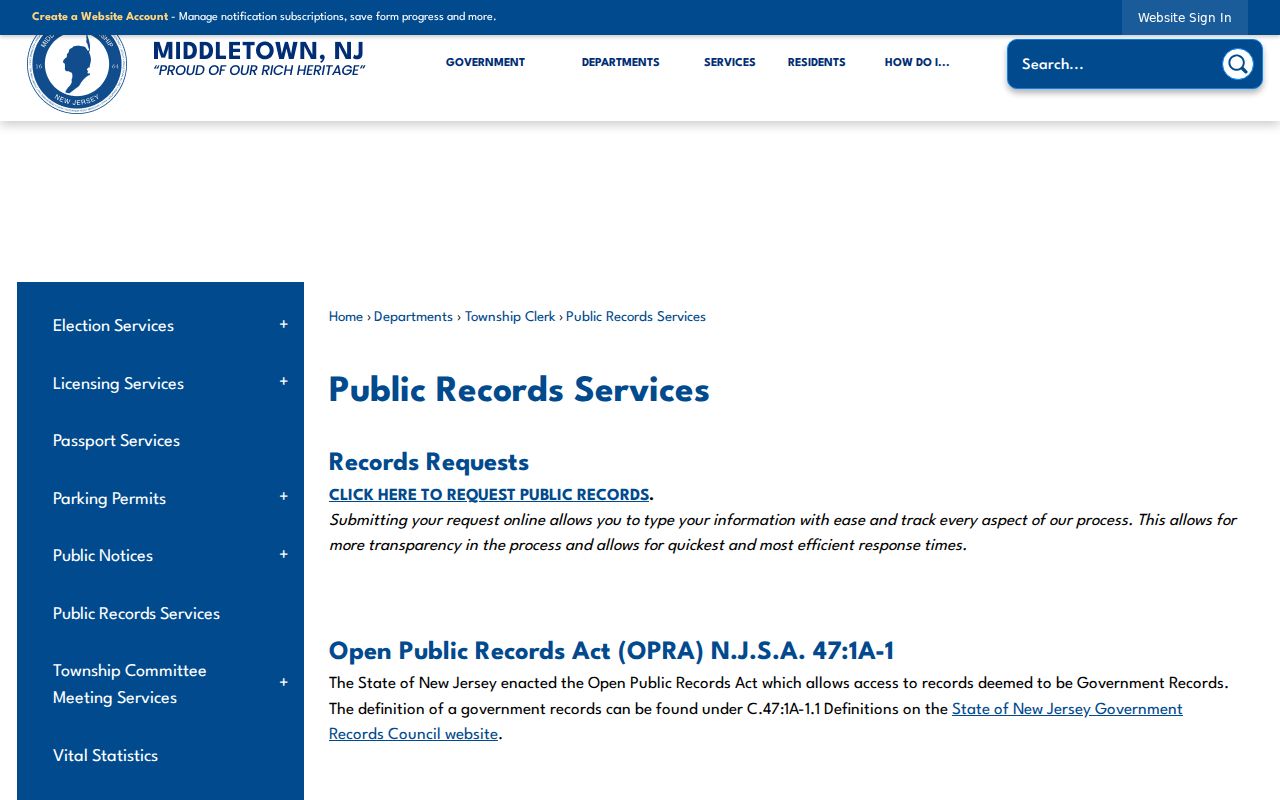
That municipal overview helps a requester select the actual record series rather than treating an OPRA request as a general name search.
The township's OPRA request form shows the request-description, delivery, authorization-cost, and certification fields used for a written request.
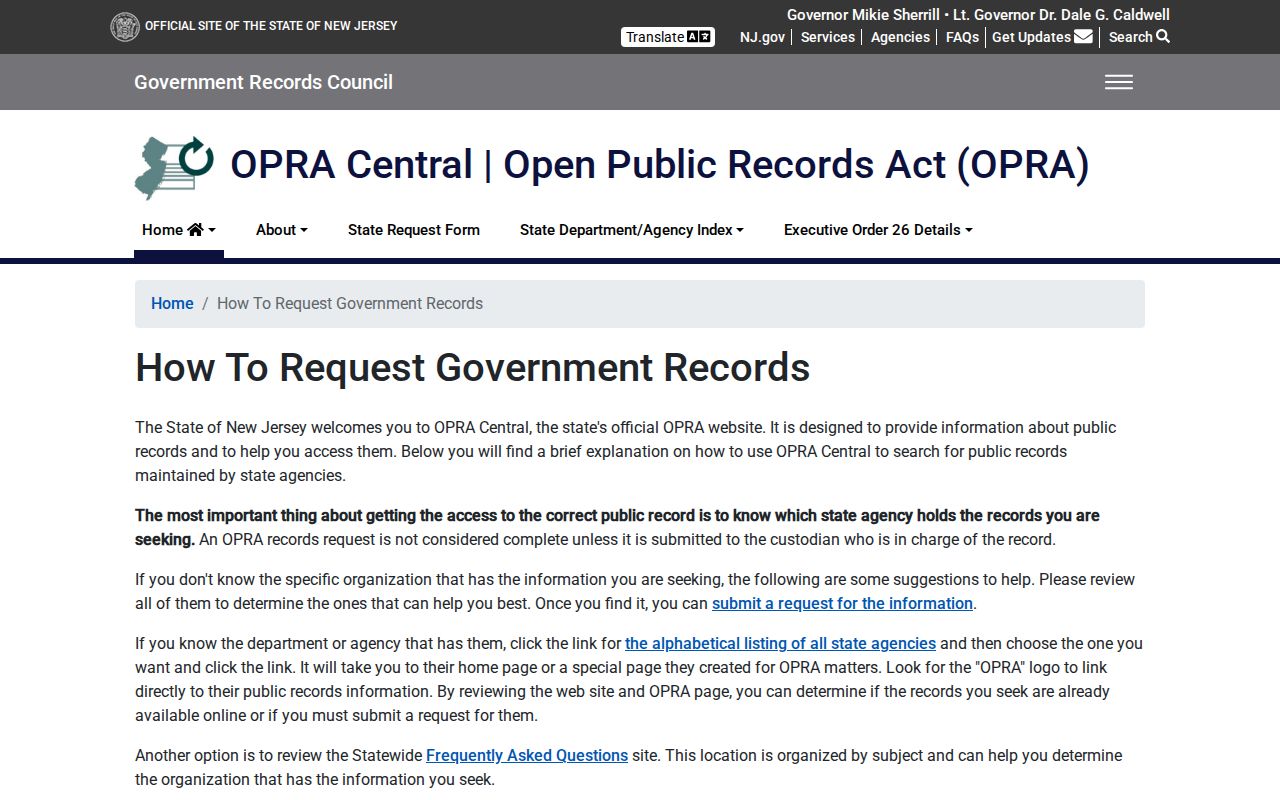
A precise record description can make a missing online item easier for the custodian to locate or explain.
Monmouth County OPRA describes the county's online transition and its paper-form fallback.
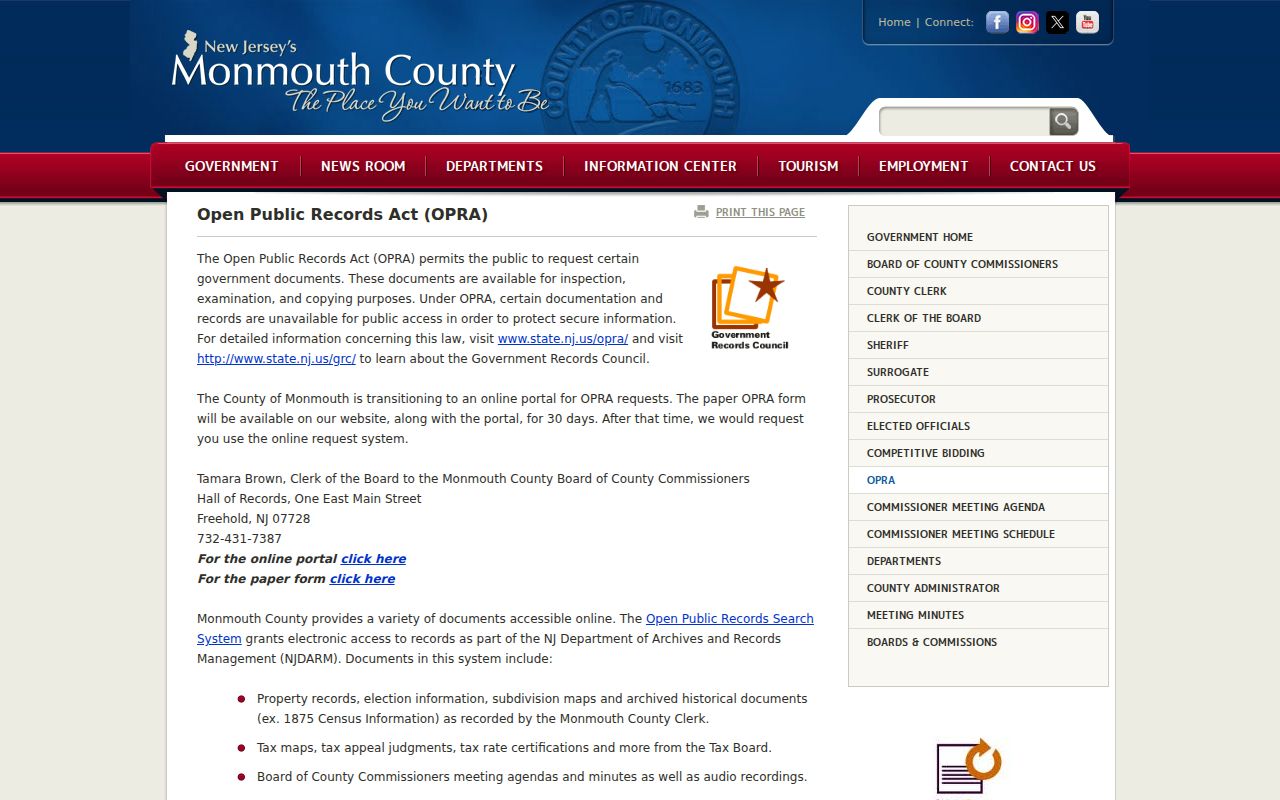
For county material, the record series and custodian remain more important than a broad name-only request.
Municipal requests can seek inspection, pickup, mail, fax, or email delivery where the form and record permit it. County and township custodians may need time to identify a series, review exemptions, calculate special service, or provide a written delay notice. The request should not ask for an investigation or a new compilation. Giving a precise street, block and lot, meeting date, instrument reference, file type, or range of years lets the custodian answer the actual records question, including when the correct answer is that no responsive record was located.
Middletown Historical Directory Shelves
Historical Middletown research depends on collections with different geographic scopes. Monmouth county directory runs include 1875, later nineteenth-century editions, early twentieth-century editions, and a 1914 farm and business directory. A rural household may be filed under a village, a route, or a neighboring post office rather than a modern street. The county's 1875 census search, obituary indexes, church records, deeds, tax ratables, and maps help test the directory clue.
Library historical rooms, the Monmouth County Historical Association, the New Jersey Historical Society microfilm holdings, and the State Archives each offer a different access channel. Some materials are non-circulating, appointment-based, on microfilm, or available only in a reading room. The full collection-by-collection treatment is in the Middletown City Directories.
Nearby Red Bank resources are a useful regional layer, not an automatic Middletown record set. Its Local History Room has directories for 1938 through 1981, while the digital archive includes regional newspapers, Sanborn maps, and yearbooks. These materials can identify a school, church, business, organization, or nearby family connection that gives a Middletown searcher a new term to test. The regional scope should remain visible in the citation so an adjacent-community entry is not relabeled as a township address.
Note: Preserve a directory's printed spelling, year, publisher, page, and village label instead of silently converting it to a current address.
Middletown Record Geography Changes
Middletown's official history begins with settlement in the 1660s, the Monmouth Patent in 1665, and the First Town Book in 1667. The original township once covered more territory than it does today. Raritan Township was formed from part of it in 1848, and later municipal changes followed. An early reference may therefore belong to the present township, a former larger township, the county, a church, or a neighboring community.
Village names also matter. Navesink was once Riceville, while Holland was associated with the area around Laurel Avenue. Middletown Village developed around a grid along Kings Highway. Searching those historical terms alongside the modern township name can recover a directory, newspaper, map, or church reference that a current postal label misses.
Record geography also explains why a modern ZIP is not a reliable historical key. The township's official list has twelve delivery-area labels but eleven distinct five-digit codes because Middletown, New Monmouth, and North Middletown share 07748. Postal labels can name nearby places such as Red Bank, Atlantic Highlands, Holmdel, Highlands, or Rumson. Keep the postal place, neighborhood, legal municipality, and parcel identifiers in separate fields instead of silently treating any one as the other.
Protected Middletown Record Details
OPRA opens many records but does not erase privacy law. Social Security numbers, financial account data, unlisted telephones, driver-license information, sensitive dates of birth, medical information, juvenile material, domestic-violence information, and other protected fields may be redacted. New Jersey's Address Confidentiality Program and Daniel's Law can protect qualifying home-address information. Recent vital records, protected voter fields, MVC records, and sealed court material have their own limits.
A good record note states what the source shows and what it cannot show. It does not copy an unneeded identifier, build a profile from unrelated records, or turn a missing field into a claim that the source is wrong.
The New Jersey Data Privacy Act creates rights and obligations for covered businesses, but publicly available government records are treated differently from data held by a covered business. A request to correct or remove a government record therefore belongs with its custodian or a specific statutory protection process, not an unrelated business privacy channel. The limited research practice is straightforward: quote only the necessary field, preserve the source and date, and request a correction from the original keeper when an underlying record appears inaccurate.
The New Jersey OPRA statute summary explains the public-access presumption alongside privacy expectations and redactions.
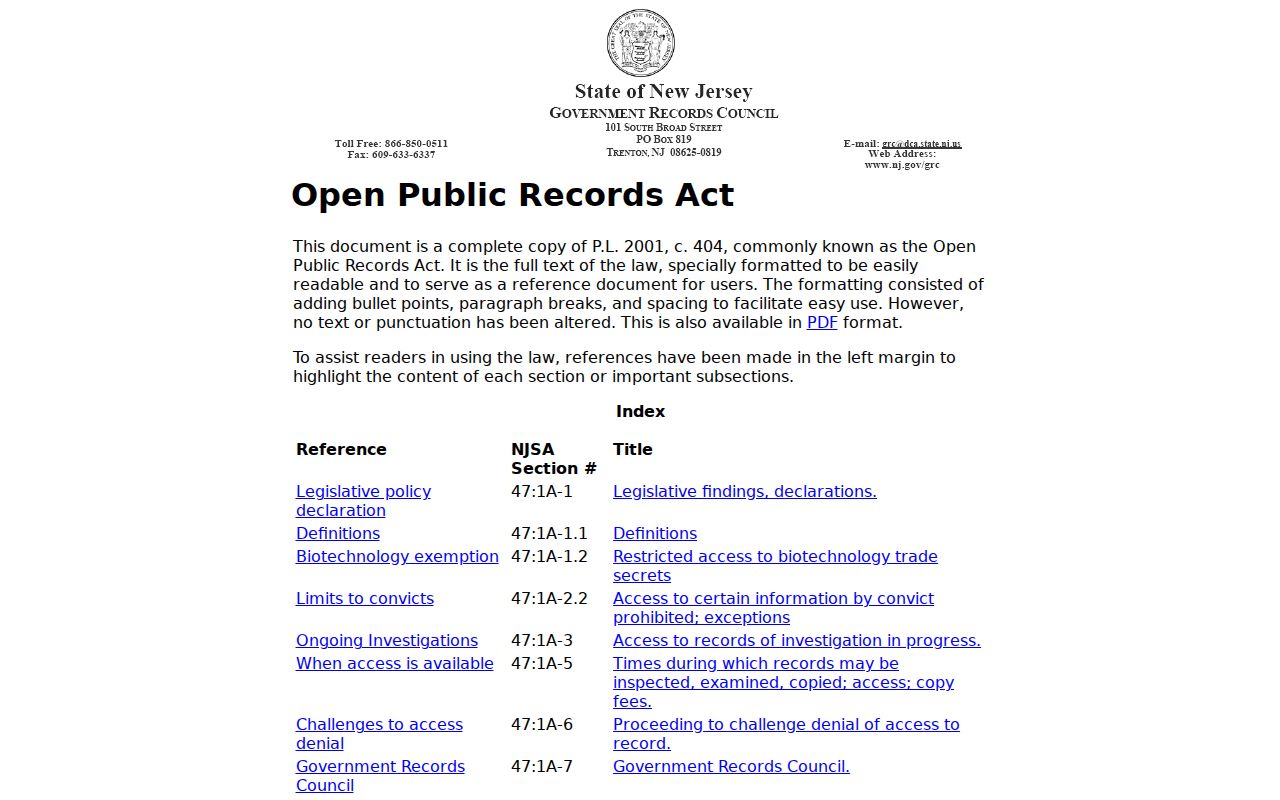
Privacy limits are part of the record's meaning, not a reason to infer that a protected detail should be supplied elsewhere.
When Middletown Indexes End
A no-result does not prove that a person never lived in Middletown. The record may be outside the database's date range, filed under an earlier village name, un-digitized, confidential, or held by a different custodian. County OPRS is a strong first stop, yet the County Clerk, Tax Board, Historical Commission, Library Historical Room, MCHA, State Archives, and Rutgers-era holdings supply the follow-up routes for distinct record types.
For a state custody question, the New Jersey Department of Corrections offers a narrow official status source, while no current public Monmouth County roster was located in the research. A custody result is not a current-address record. Use the County's contact directory to reach the appropriate office rather than assuming that an absent online listing means no record exists.
The Monmouth County phone directory is a useful routing source for the Clerk, Elections, Surrogate, Library, Correctional Institution, and other custodians.
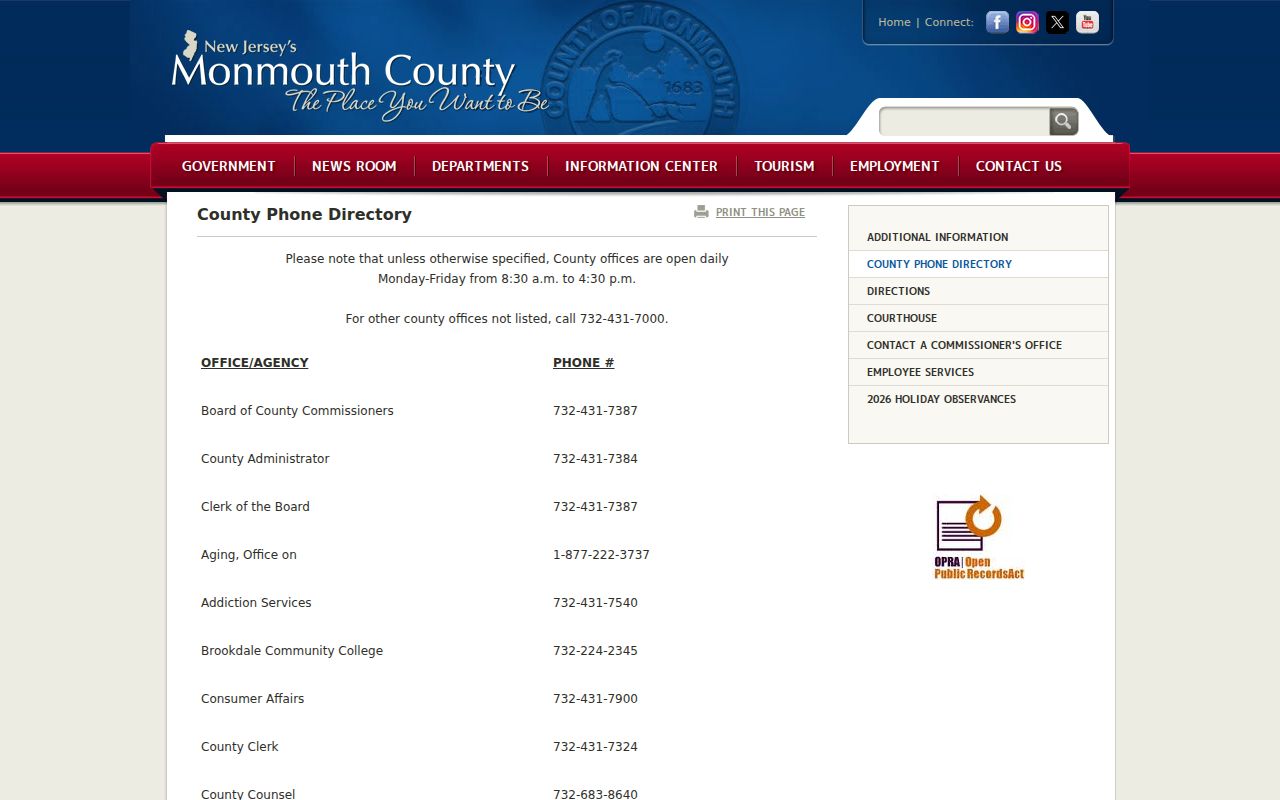
Routing a focused question to the right office is often more productive than repeating the same online search.
The official New Jersey Department of Corrections search is limited to the state system and should be read with its own currentness and scope cautions.
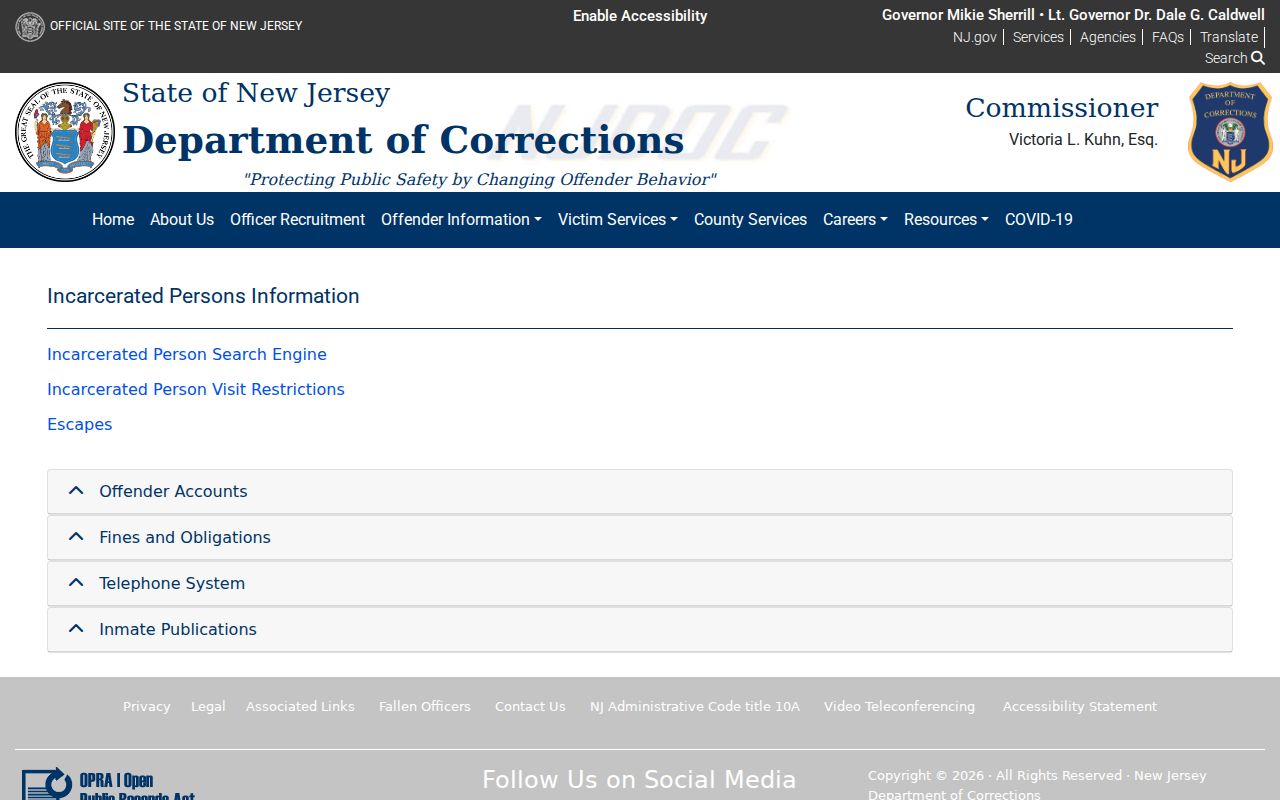
Keeping a custody record separate from a residence question avoids an unsupported conclusion about where a person lives.
A missing portal result can also reflect a technical boundary. OPRS categories have different search fields and record histories. An archive collection may be indexed but not digitized. A library database may need a card, account, affiliate connection, or onsite terminal. An estate or court record may have a scope notice, a delay, or a confidential portion. State the limitation beside the result rather than filling the gap with an unrelated source. That practice is especially important when an online record seems to stop at a date that the physical collection reaches beyond.
Historical Middletown Resident Directories
Historic Monmouth directories preserve a name, occupation, household clue, post office, or business at a particular publication date. They can be paired with the 1875 census search, tax ratables, deeds, newspapers, cemetery and church material, and MCHA's obituary indexes. Middletown Baptist Church microfilm reaches into the eighteenth and nineteenth centuries, while the printed county directories become especially useful from 1875 onward.
Read each volume as a dated source. An entry can omit women, children, boarders, rural households, or people outside the publisher's coverage. The collection, its access channel, and the years it reaches are documented in the Middletown City Directories collection page.
Reverse or criss-cross work starts with a historic street or house number in an address section, then checks the alphabetical listing and a second edition. A 1914 farm-directory entry may contain a spouse, children, occupation, tenure, acreage, telephone notation, township, rural route, and map clue. Preserve abbreviations and printed spellings. Do not turn a rural route or post-office label into a modern house number without a dated map, deed, or other supporting record.